
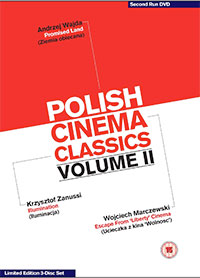
 Almost a year to the day after Second Run released its first collection of Polish Cinema Classics, they brought out a second volume. Whereas the first consisted of four films from Polish cinema’s first golden era (the late 50s/early 60s), this triple-bills three very different films whose only real point in common is their creative excellence and the reputation of their makers – at least at home. (In the UK, Wojciech Marczewski is all but unknown compared with Andrzej Wajda and Krzysztof Zanussi, but that has far more to do with lack of access than lack of merit.) Second Run also pulled off a genuine coup in securing the world DVD premiere of the original theatrical cut of Wajda’s The Promised Land (Ziemia obiecana, 1974), previously only available on DVD in the director’s contentiously truncated 2000 cut or the four-part TV edit from 1978. Zanussi’s Illumination (Iluminacja, 1972) and Marczewski’s Escape from the ‘Liberty’ Cinema (Ucieczka z kina ‘Wolność’) are both available in Poland, but in transfers ranging from adequate to terrible, whereas all three films here have benefited from the same kind of wholesale digital restorations that fuelled Second Run’s first box – director-approved in all three cases.
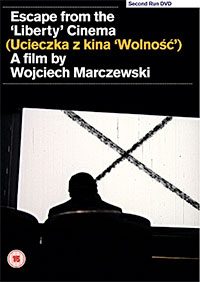 I wrote the booklet for Escape from the ‘Liberty’ Cinema, which also gave me an excellent opportunity to delve into the rest of Wojciech Marczewski’s hugely impressive back catalogue. I uncovered a surprising amount of it, including his early TV movies Easter (Wielkanoc, 1974), Whiter Than Snow (Bielszy niż śnieg, 1975) and The Steward (Klucznik, 1979), plus his first two cinema features, Nightmares (Zmory, 1978) and Shivers (Dreszcze, 1981) – the latter in particular, with its semi-autobiographical portrait of a summer at a Stalinist holiday camp (!) would make a brilliant Second Run release in its own right, and apparently it was a toss-up between that and Escape from the ‘Liberty’ Cinema. But I can see why they picked the latter: its portrait of a jaded provincial censor trying to deal with the cast of a completed film rebelling against its banal and compromised story and dialogue (in a medium-bending conceit consciously lifted from Woody Allen’s The Purple Rose of Cairo) is much more accessible and its are concerns far more universal.
Unsurprisingly for someone so little known outside Poland, there was a distinct paucity of material on Marczewski to draw on, but the booklet for the Polish box set of his first three features included some useful interviews, and I also managed to track down a copy of the only book about his work (Andrzej Szpulak’s Filmy Wojciecha Marczewskiego, 2009), which included an entire chapter on ‘Liberty’ Cinema – it was much more analytical than factual, and I’d already written the bulk of my booklet essay when the book arrived, but it had a few exploitable nuggets.