
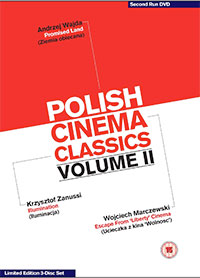
 Almost a year to the day after Second Run released its first collection of Polish Cinema Classics, they brought out a second volume. Whereas the first consisted of four films from Polish cinema’s first golden era (the late 50s/early 60s), this triple-bills three very different films whose only real point in common is their creative excellence and the reputation of their makers – at least at home. (In the UK, Wojciech Marczewski is all but unknown compared with Andrzej Wajda and Krzysztof Zanussi, but that has far more to do with lack of access than lack of merit.) Second Run also pulled off a genuine coup in securing the world DVD premiere of the original theatrical cut of Wajda’s The Promised Land (Ziemia obiecana, 1974), previously only available on DVD in the director’s contentiously truncated 2000 cut or the four-part TV edit from 1978. Zanussi’s Illumination (Iluminacja, 1972) and Marczewski’s Escape from the ‘Liberty’ Cinema (Ucieczka z kina ‘Wolność’) are both available in Poland, but in transfers ranging from adequate to terrible, whereas all three films here have benefited from the same kind of wholesale digital restorations that fuelled Second Run’s first box – director-approved in all three cases.
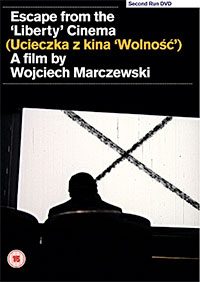 I wrote the booklet for Escape from the ‘Liberty’ Cinema, which also gave me an excellent opportunity to delve into the rest of Wojciech Marczewski’s hugely impressive back catalogue. I uncovered a surprising amount of it, including his early TV movies Easter (Wielkanoc, 1974), Whiter Than Snow (Bielszy niż śnieg, 1975) and The Steward (Klucznik, 1979), plus his first two cinema features, Nightmares (Zmory, 1978) and Shivers (Dreszcze, 1981) – the latter in particular, with its semi-autobiographical portrait of a summer at a Stalinist holiday camp (!) would make a brilliant Second Run release in its own right, and apparently it was a toss-up between that and Escape from the ‘Liberty’ Cinema. But I can see why they picked the latter: its portrait of a jaded provincial censor trying to deal with the cast of a completed film rebelling against its banal and compromised story and dialogue (in a medium-bending conceit consciously lifted from Woody Allen’s The Purple Rose of Cairo) is much more accessible and its are concerns far more universal.
Unsurprisingly for someone so little known outside Poland, there was a distinct paucity of material on Marczewski to draw on, but the booklet for the Polish box set of his first three features included some useful interviews, and I also managed to track down a copy of the only book about his work (Andrzej Szpulak’s Filmy Wojciecha Marczewskiego, 2009), which included an entire chapter on ‘Liberty’ Cinema – it was much more analytical than factual, and I’d already written the bulk of my booklet essay when the book arrived, but it had a few exploitable nuggets.
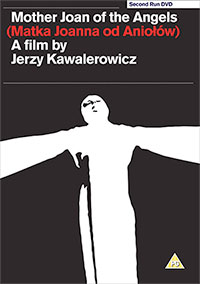 Back in 2005, one of Second Run’s very first releases was Jerzy Kawalerowicz’s Mother Joan of the Angels (Matka Joanna od aniołów, 1961). Back then, the label had a guiding philosophy that it was more important to get a particular film out there in an English-friendly edition than it was to secure the best possible source, and so the fact that it was only available in a clearly elderly analogue tape master wasn’t considered a major drawback. The grey and smeary end result was, frankly, VHS quality, but the excellence of the film itself meant that it got surprisingly sympathetic reviews, thus vindicating their strategy at the time.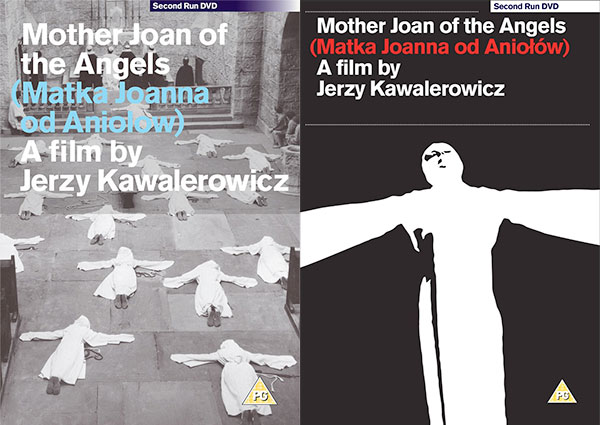
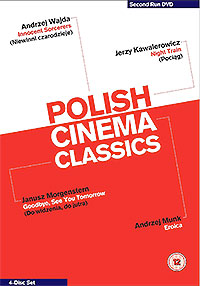 Second Run’s latest box set is out today, but while its predecessors simply repackaged older single-disc releases in a more attractively-priced collection, this one contains brand new releases in the form of four Polish films from the turn of the 1960s that have long achieved classic status at home but which are still comparatively little known in Britain: Andrzej Munk’s Eroica (1958), Andrzej Wajda’s Innocent Sorcerers (Niewinni czarodzieje, 1960), Jerzy Kawalerowicz’s Night Train (Pociąg, 1959) and Janusz Morgenstern’s Goodbye, See You Tomorrow (Do widzenia, do jutra, 1960), all taking advantage of new high-definition digital restorations commissioned by the newly reconstituted Studio Kadr and supervised by the films directors and/or cinematographers, if still alive. I wrote the booklets for the last two titles, which presented different challenges.
 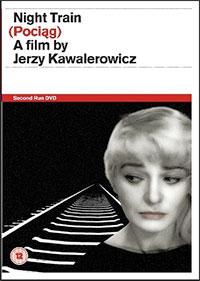 Night Train was the most straightforward: I’d written a thousand-word piece about it in the past, so recycled bits of that, and added a more detailed character study (in which I had to devise names for many of the train’s passengers, as they’re not given in the actual film) and a biography of Kawalerowicz. The latter gave me an excuse to watch as many of his films as I could track down: this was easier with the 1950s and 60s titles (I saw everything from 1953′s Cellulose/Celuloza to 1966′s Pharaoh/Faraon) than it was for many of the later ones – I don’t think I’ve ever had the chance to see his Italian film Maddalena (1971), a film that’s best known for its Ennio Morricone score (although far more people know it as the theme to the BBC series The Life and Times of David Lloyd George), although I was able to see Death of a President/Śmierć prezydenta (1977) and Austeria (1982).
 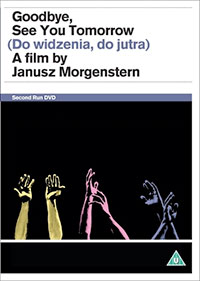 Goodbye, See You Tomorrow was markedly tougher given the comparative lack of research material in English. A major godsend for background material was the booklet in Best Film Co’s 50 Years of the Polish Film School box set, whose essay by Marek Hendrykowski provided a fair amount of detail, as did a comparative study of this film and Three Colours: White by Elzieta Ostrowska and Joanna Rydzewska. A chance discovery of Kathleen M. Cioffi’s book Alternative Theatre in Poland 1954-1989 provided essential background on the experimental theatre scene that fuelled Zbigniew Cybulski’s original script and his approach to realising it onscreen. I also found a long interview with director Janusz Morgenstern in Gazeta Wyborcza, which provided useful biographical info (unlike the situation with Kawalerowicz, most of Morgenstern’s films aren’t easily viewable, even on unsubtitled video copies). Almost at the last minute, I realised that this would be a heaven-sent opportunity to quote from Alexei Sayle’s hilarious memoir Stalin Ate My Homework, specifically the bit where he decides to use Cybulski as a role model, with disastrous consequences.
 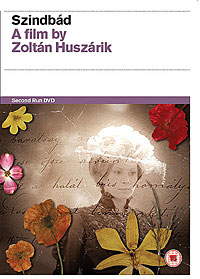 Second Run’s DVD edition of Zoltán Huszárik’s masterpiece Szindbád comes out today, and reviews have generally been ecstatic.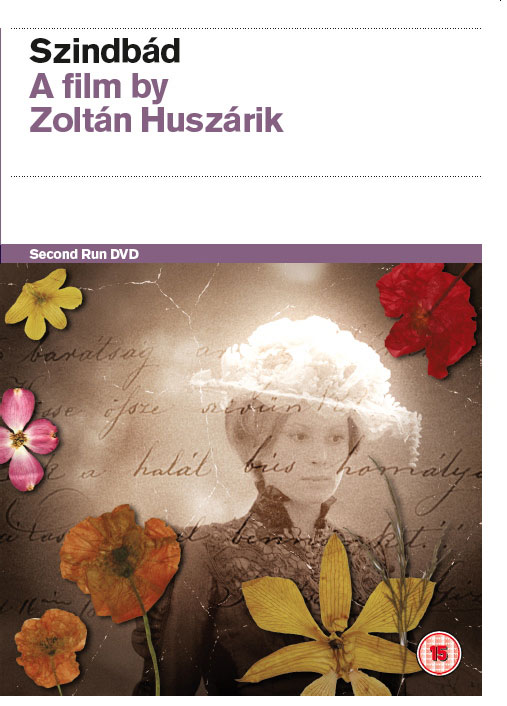
 Second Run’s latest DVD is out today, complete with a 5,000-word booklet essay by yours truly. Compared with the research challenges posed by the two Jan Němec films (
 Second Run’s second Jan Němec film is released today, complete with a video appreciation from Peter Hames and a booklet essay from yours truly. None of the reviewers have spotted this yet, but a fair chunk of the second half was essentially recycled from the booklet for
  My third Second Run contribution is a fairly considerable departure from the first two (
 Today sees the British DVD premiere of one of the best films of the Czech New Wave, complete with a video appreciation by Peter Hames and a booklet essay by me. It’s comfortably the longest booklet piece I’ve written to date, largely because Second Run didn’t give me a word limit, and I thought I’d use this as an opportunity to do some serious digging into Němec’s entire career: at the time the booklet was commissioned, I’d only seen his first two features (Diamonds of the Night and this).