
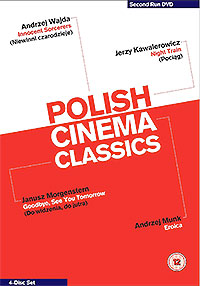
 Second Run’s latest box set is out today, but while its predecessors simply repackaged older single-disc releases in a more attractively-priced collection, this one contains brand new releases in the form of four Polish films from the turn of the 1960s that have long achieved classic status at home but which are still comparatively little known in Britain: Andrzej Munk’s Eroica (1958), Andrzej Wajda’s Innocent Sorcerers (Niewinni czarodzieje, 1960), Jerzy Kawalerowicz’s Night Train (Pociąg, 1959) and Janusz Morgenstern’s Goodbye, See You Tomorrow (Do widzenia, do jutra, 1960), all taking advantage of new high-definition digital restorations commissioned by the newly reconstituted Studio Kadr and supervised by the films directors and/or cinematographers, if still alive. I wrote the booklets for the last two titles, which presented different challenges.
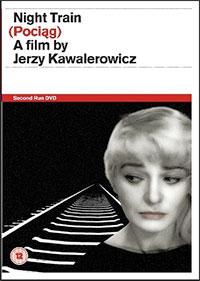 Night Train was the most straightforward: I’d written a thousand-word piece about it in the past, so recycled bits of that, and added a more detailed character study (in which I had to devise names for many of the train’s passengers, as they’re not given in the actual film) and a biography of Kawalerowicz. The latter gave me an excuse to watch as many of his films as I could track down: this was easier with the 1950s and 60s titles (I saw everything from 1953′s Cellulose/Celuloza to 1966′s Pharaoh/Faraon) than it was for many of the later ones – I don’t think I’ve ever had the chance to see his Italian film Maddalena (1971), a film that’s best known for its Ennio Morricone score (although far more people know it as the theme to the BBC series The Life and Times of David Lloyd George), although I was able to see Death of a President/Śmierć prezydenta (1977) and Austeria (1982).
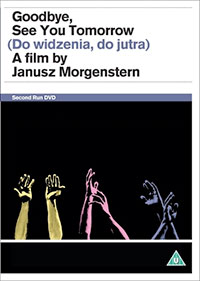 Goodbye, See You Tomorrow was markedly tougher given the comparative lack of research material in English. A major godsend for background material was the booklet in Best Film Co’s 50 Years of the Polish Film School box set, whose essay by Marek Hendrykowski provided a fair amount of detail, as did a comparative study of this film and Three Colours: White by Elzieta Ostrowska and Joanna Rydzewska. A chance discovery of Kathleen M. Cioffi’s book Alternative Theatre in Poland 1954-1989 provided essential background on the experimental theatre scene that fuelled Zbigniew Cybulski’s original script and his approach to realising it onscreen. I also found a long interview with director Janusz Morgenstern in Gazeta Wyborcza, which provided useful biographical info (unlike the situation with Kawalerowicz, most of Morgenstern’s films aren’t easily viewable, even on unsubtitled video copies). Almost at the last minute, I realised that this would be a heaven-sent opportunity to quote from Alexei Sayle’s hilarious memoir Stalin Ate My Homework, specifically the bit where he decides to use Cybulski as a role model, with disastrous consequences.