 My third Second Run contribution is a fairly considerable departure from the first two (The Party and the Guests and Valerie and her Week of Wonders). Although I generally specialise in writing about European cinema, and indeed have no real track record when it comes to the Australian variety, I was commissioned to contribute a booklet essay to accompany Ann Turner’s debut Celia after I let slip that I’d been peripherally involved with the original UK cinema release in 1990 (I worked for the Everyman Cinema, which at the time had strong links with independent distributors Electric Pictures – which effectively meant that I was frequently roped in to help with their releases).
I particularly remembered this one, because the reviews were terrific, and yet it sank like a stone when it opened – a sobering lesson that critical acclaim may not be enough if the public doesn’t seem to be that keen to watch an Australian film made by and starring complete unknowns. Another useful lesson came from my first professional encounter with the British Board of Film Classification, which raised concerns about possible animal cruelty – proscribed by the 1937 Cinematograph Films (Animals) Act. Handily, the producers had anticipated issues like this, and were able to prove that the shot in question had been simulated, so the BBFC gave it a 15 without requesting cuts.
I’d always liked the film, and it stood up very well indeed – in fact, now that I’m a father myself it resonated with me much more deeply. The relationship between Celia and her father Ray is particularly well drawn: Turner both manages to get inside Celia’s head, with all the impulsiveness and unreasonableness that that implies, while at the same time presenting an entirely objective view of a man who isn’t wicked by any sensible yardstick – merely honestly baffled by his daughter’s obsessions and trying to do good by them while simultaneously trying to stay in line with the small-c conservative community that they inhabit.
The BFI Library was a major godsend when researching the piece, as they turned out to have an extensive collection of Australian magazines and cuttings, enabling me to trace the film’s long gestation (it won an award for Best Unproduced Script) as well as its reception both in its native country and elsewhere. The British reviews were every bit as good as I remembered, but I also found out that the US release was a disaster. It was already arguably a mistake for the British poster to hint that it might be a horror film (it’s much subtler than that), but the US version went the whole hog and retitled it Celia: Child of Terror. Ann Turner strongly objected, but she had no contractual veto, and the film duly died a death.
My booklet essay is a fair bit shorter than the one I wrote for The Party and the Guests, largely because I knew in advance that it would be sharing space with another piece, by Australian academic Joy Damousi, and the original folktale ‘The Hobyahs’. I was given a copy of Professor Damousi’s piece in advance, so that I could avoid overlapping material – and I tailored my piece so that it was more or less the same length.
Given the issues over previous ad campaigns, I was intrigued to see what Second Run would come up with for their cover. I knew in advance that they were determined to avoid the horror-film trap, and instead they came up with this:

The multiple layers of symbolism make more sense if you’ve seen the film, but the colour red is as important as the rabbits and the ghostly Hobyahs that can be seen scuttling out of the picture at the bottom.
Reviews
…plus more links in Second Run’s own webpage devoted to the film.
 Second Run’s second Jan Němec film is released today, complete with a video appreciation from Peter Hames and a booklet essay from yours truly. None of the reviewers have spotted this yet, but a fair chunk of the second half was essentially recycled from the booklet for
 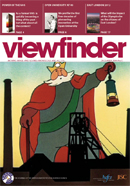 The December 2009 issue of Viewfinder, the journal of the British Universities Film & Video Council, includes a cover feature in which I write about the BFI’s This Working Life project in general, with specific case studies drawn from the recent King Coal season, illustrating how it was promoted in cinemas, on DVD and across various online platforms. Full contents list
 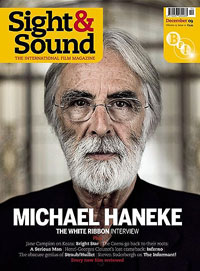 The latest Sight & Sound is out, complete with the following pieces by me:
 The latest Sight & Sound is out, complete with the following pieces by me:
 The February 2009 issue of Sight & Sound is out now, complete with the following contributions by me:
 BFI Screenonline has just updated its homepage, the main feature showcasing the British short films of silhouette animator Lotte Reiniger. I wrote pieces on
  The January 2009 issue of Sight & Sound has been delivered, and includes the following pieces under my byline: