Nicolas Roeg at the Riverside

Tomorrow I’ll be chairing a panel discussion at the Riverside Studios Cinema as part of their ambitious three-day Nicolas Roeg retrospective, jointly organised by the London Film Academy.

As far as I’m aware, the line-up includes Luc Roeg (producer of Two Deaths and co-star of Walkabout), Jeremy Thomas (producer of Bad Timing, Eureka and Insignificance), Tony Lawson (assistant editor of Don’t Look Now and then editor of all Roeg’s films from 1980-1995) and Jason Wood (writer and curator of the Riverside season) – so I suspect I won’t have very much to do except keep all the anecdotes under control.

UPDATE: Sadly, Luc Roeg had to drop out for medical reasons, but everything else went ahead as scheduled, and proved to be just about the most enjoyable event I’ve ever chaired – and Tony Lawson’s mini-masterclass on editing a couple of particularly intricate sequences from Bad Timing was worth the trip on its own.

Screenonline in September

The new Screenonline homepage for September 2008 has just been published, including a look at the GPO Film Unit, the Free Cinema movement and BFI-funded animation.

I wrote most of the last collection, including the introduction and individual entries on Anthony Gross and Hector Hoppin’s Round the World in 80 Days, Joan and Peter Foldes’ A Short Vision (1955), Peter King’s Thirteen Cantos of Hell, Mel Calman’s The Arrow (1969), Abu’s No Arks (1969), Antoinette Starkiewicz’s High Fidelity (1976) and Martyn Pick’s Signature (1990) – and the collection also revives older pieces on the Quay Brothers’ Nocturna Artificialia (1979) and Street of Crocodiles (1986).

My other new Screenonline work includes pieces on the recent Timothy Spall vehicle Pierrepoint (2005), James Bond films Diamonds Are Forever (1971) and The Man with the Golden Gun (1974), some turn-of-the-20th-century films from the Warwick Trading Company – Feeding the Tigers, Highland Reel and Metropolitan Fire Brigade Turn-Out (all 1899).

Valerie and her Week of Wonders

Today sees the release of Second Run’s remastered DVD edition of Jaromil Jireš’ classic Czech fantasy-horror Valerie and her Week of Wonders. In addition to a newly-created trailer, an interview with star Jaroslava Schallerova, and a booklet with essays by Peter Hames and Valerie Project founder Joseph A. Gervasi, the package features my own 20-minute illustrated video introduction.

Introduction

This blog is designed as a central reference point for all my various writings, talks, DVD productions and other activities – in fact, its primary function is to enable me to keep track of everything myself!

Many of the people who visit it will probably know me personally, but here’s a brief career sketch for those who don’t. After some amateurish dabblings in film criticism at university in the late 1980s, my first professional writing job involved coming up with virtually all the content of the Hampstead Everyman Cinema’s printed bi-monthly programmes (initially 8-page A3, then 16-page A4, with up to 150 films covered per issue) between Julys 1989 and 1995. It was an invaluable apprenticeship, not least for the experience it gave me in writing quickly and concisely to tight deadlines, since a film or several would almost invariably drop out just before the printers needed final copy.

I then spent the mid-to-late 1990s posting what I initially thought were ephemeral opinions on various online forums (notably alt.cult-movies) before writing regular DVD reviews for DVD Times starting in late 1999. At roughly the same time I started contributing shorter pieces to MovieMail’s monthly catalogue. I also occasionally wrote for Videovista and the now defunct Bullets’n’Babes (I’ll be archiving the pieces I wrote for the latter on this blog in due course).

In April 2002, I began working at the BFI as the full-time content developer for Screenonline, a gigantic multimedia encyclopaedia of British film and television history. Starting almost from scratch, the site was launched in November 2003, and has expanded on a more or less monthly basis ever since. Almost by default, since I’m Screenonline’s only full-time writer, I’m very comfortably its most prolific contributor.

My first Sight & Sound piece was published in the September 2002 edition, and from January 2005 I began to write film reviews for them on a semi-regular basis. Since February 2006, I have had a piece published in every issue, and a year later I became part of their regular DVD review team, covering at least eight releases a month. I have also written occasional features and interviews (notably with Andrzej Wajda). I have also written occasionally for Vertigo magazine, for whom I interviewed Guy Maddin and Jan Švankmajer. Kinoblog, my dedicated Central and Eastern European cinema blog, was launched in June 2007.

Although I spend far more time writing about DVDs than contributing to them, I produced the BFI’s acclaimed Quay Brothers and Jan Švankmajer short-film compilations, contributed a video introduction to Second Run’s Valerie and her Week of Wonders, and occasional booklet and sleevenote contributions to other releases.

Since 2003, I’ve been regularly chairing live events at the BFI and elsewhere, involving:

  • Armando Iannucci (writer-producer, The Day Today/The Thick of It)
  • Michael Kuhn (producer, former head of PolyGram Filmed Entertainment)
  • Martin Lambie-Nairn (graphic designer)
  • Rebecca O’Brien (Ken Loach’s regular producer)
  • Gary Tarn (director, Black Sun)

…and I’ve also given solo talks on Ken Russell’s 1960s BBC output and Andrzej Wajda at BFI Southbank.

Sight & Sound: December 2007

Cover of Sight & Sound December 2007The latest Sight & Sound is out, complete with the following pieces by me:

  • Ex Drummer (p. 61) – review of Koen Mortier’s would-be transgressive Belgian drama, which tries a little too hard to offend everybody;
  • The Extras (p. 62) – review of Michał Kwieciński’s enjoyable if formulaic Polish-Chinese culture-clash romantic comedy;
  • ‘Gods and monsters (p. 100) – review of Masters of Cinema’s latest F.W. Murnau DVDs: Nosferatu and Tabu;
  • Bamako (p. 101) – review of Artificial Eye’s DVD of Abderrahmane Sissako’s politically adventurous Malian drama;
  • The Brides of Dracula (p. 101) – review of Showbox’s DVD of Hammer’s sequel to their groundbreaking Dracula, without Christopher Lee but Peter Cushing’s Van Helsing is ample compensation;
  • Gabrielle (p. 102) – review of Artificial Eye’s DVD of Patrice Chéreau’s deliberately stifling adaptation of Joseph Conrad’s The Return;
  • Golden Door (p. 102) – review of Optimum’s DVD of Emanuele Crialese’s sumptuously mounted drama about Sicilian immigrants to the New World;
  • It’s Winter (p. 102) – review of Artificial Eye’s DVD of Rafi Pitts’ appropriately chilly portrait of an unemployed Iranian man;
  • Films by René Laloux (p. 102) – reviews of Masters of Cinema’s separate DVD editions of Les Maîtres du temps and Gandahar, lesser-known sci-fi animated features by the maker of Fantastic Planet;
  • Theorem (p. 103) – review of the BFI’s excellent edition of Pier Paolo Pasolini’s perennially perplexing film-puzzle;
  • I Even Met Happy Gypsies (p. 105) – review of Delta Video’s DVD of Aleksandar Petrović’s Yugoslav cinema milestone: forgotten in the West but a clear influence on Emir Kusturica and Tony Gatlif’s gypsy films;
  • Ten Bad Dates with De Niro – A Book of Alternative Movie Lists (p. 109) – review of Richard Kelly’s entertaining compilation, including such delights as ‘Ten of the Unlikeliest Films Ever Judged the Best of All Time’, ‘Ten Films That Traumatised Me When I Was Younger’ and ‘Manicure Madness’ (‘Ten Shining Examples of Notable Nail Varnish’).

Sight & Sound: November 2007

Cover of Sight & Sound November 2007The latest Sight & Sound is out, complete with the following pieces by me:
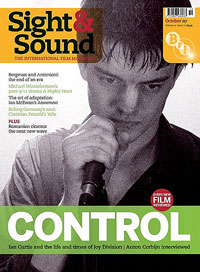
  • review of Day Watch (d. Timur Bekmambetov, Russia, 2006);
  • review of My Nikifor (d. Krzysztof Krauze, Poland, 2004);
  • introduction to the films of Robert Bresson;
  • short DVD review of Edvard Munch (d. Peter Watkins, Norway/Sweden, 1974);
  • short DVD review of Peter Whitehead in the Sixties (BFI);
  • short DVD review of The Ballad of Narayama (d. Keisuke Kinoshita, Japan, 1958);
  • short DVD review of Sergei Eisenstein Volume 1 (Tartan)

Sight & Sound: October 2007

Cover of Sight & Sound October 2007The latest Sight & Sound is out, with the following contributions from yours truly:

  • Testosterone (p.74) – the first in what promises (or threatens) to be a whole series of contemporary Polish films turns out to be an ensemble piece about various fronts in the sex war, shot in a style that’s none too subtly indebted to Reservoir Dogs;
  • Tough Enough (p. 76) – I’d almost forgotten I’d written this, as it was commissioned months ago but the film’s UK release kept getting postponed. Anyway, it’s a German slice of Loachian social realism about a Berlin teenager forced to move to and cope with a very different environment after his mother is thrown out by her rich boyfriend;
  • 12:08 East of Bucharest (p.77) – I’d first seen this a year ago in a massive open-air cinema at the Sarajevo Film Festival (where it was the opening night attraction), but this slyly satirical look at unreliable memories (of the intentional and unintentional kind) proved just as funny when seen in a Soho screening room;
  • Harold Lloyd: The Definitive Collection (p.84) – a real labour of love, this: I watched all nine discs in Optimum’s new box set avidly and was hungry for more by the end;
  • Bellissima (p. 85) – review of Masters of Cinema’s edition of Visconti’s neorealist comedy with Anna Magnani as the pushy mother of a deeply reluctant child;
  • Blue (p. 85) – review of Artificial Eye’s edition of Derek Jarman’s swansong. They could have cheated and just delivered a continuous digital blue, but this was clearly sourced from a film print, and the specks and scratches work well with Jarman’s hand-tooled aesthetic;
  • Distant Voices Still Lives (p. 85) – review of the BFI’s definitive edition of one of the old BFI Production Board’s greatest artistic triumphs: it hasn’t dated at all;
  • Irezumi (p. 86) – review of Yume’s DVD of Yasuzo Masumura’s startlingly vicious quasi-feminist melodrama, which appears to be getting its first UK release: it’s hard to imagine the BBFC of 1966 passing it uncut);
  • Silence (p. 87) – review of Masters of Cinema’s edition of Masahiro Shinoda’s Shusaku Endo adaptation, about the persecution of Japanese Christians and Portuguese missionaries in the early 17th century.
  • The Party and the Guests

    DVD cover for The Party and the GuestsToday sees the British DVD premiere of one of the best films of the Czech New Wave, complete with a video appreciation by Peter Hames and a booklet essay by me. It’s comfortably the longest booklet piece I’ve written to date, largely because Second Run didn’t give me a word limit, and I thought I’d use this as an opportunity to do some serious digging into Němec’s entire career: at the time the booklet was commissioned, I’d only seen his first two features (Diamonds of the Night and this).

    The immediate challenge, as ever in these situations, was actually getting to see much of it. Handily, the BFI National Archive had copies of his 1988 documentary Peace in Our Time? and Pawel Pawlikowski’s 1990 documentary Kids from FAMU, in which Němec was one of the interviewees, and I was able to track down American VHS copies of Oratorio for Prague (1968) and Code Name Ruby (1996) and a DVD of Late Night Talks with Mother (2001). Which wasn’t perfect – I’d have especially liked to have had the chance to see Martyrs of Love (1967), the film he made in between the completion and release of The Party and the Guests – but it was better than nothing, and meant that I could piece together a pretty comprehensive career overview from assorted interviews in English and French publications.

    A challenge when writing about the film itself was that I had to rely on an old VHS recording of a BBC2 broadcast from 2 June 1990, the last time British television showed any sustained interest in Czech cinema or indeed Czech culture in general (the same period saw the British television premiere of Jan Švankmajer’s BBC-commissioned The Death of Stalinism in Bohemia, a handful of 1960s Czech New Wave classics and various documentaries). The tape itself was still perfectly watchable, but it became very clear on closer examination that the subtitles were woefully inadequate – they translated the important dialogue, but tended to elide anything that sounded like an aside. The problem is, this film is overwhelmingly about asides, about reading (and therefore listening) between the lines, and I was very conscious that I might have missed out a potentially important detail simply because it wasn’t translated and my Czech wasn’t good enough to catch it when spoken.

    So one of the first things I checked when the Second Run DVD arrived was whether it had used the same subtitles – and I’m delighted to confirm that it has a far more comprehensive translation. I don’t think there’s anything in the booklet that I wanted to change as a result, but I can say with some authority (based on the BBC2 version and a 35mm screening that I caught at the Ciné Lumière a few years later) that this is the most English-friendly version of the film yet released. Also, full marks for the cover, which wittily alludes to a key plot point without ever resorting to spoilers – here’s an enlargement:

    DVD cover for The Party and the Guests

    Reviews

    …plus more links in Second Run’s own webpage devoted to the film.